Recursive Objects
- Press O or Escape for overview mode.
- Visit this link for a nice printable version
- Press the copy icon on the upper right of code blocks to copy the code
Class outline:
- Linked Lists
- Link class
- Tree class
Linked lists
Why do we need a new list?
Python lists are implemented as a "dynamic array", which isn't optimal for all use cases.
😭 Inserting an element is slow, especially near front of list:
😭 Plus inserting too many elements can require re-creating the entire list in memory, if it exceeds the pre-allocated memory.
Linked lists
A linked list is a chain of objects where each object holds a value and a reference to the next link. The list ends when the final reference is empty.
Linked lists require more space but provide faster insertion.
A Link class
                    class Link:
                        empty = ()

                        def __init__(self, first, rest=empty):
                            self.first = first
                            self.rest = rest
How would we use that?
ll = Link("A", Link("B", Link("C")))
A fancier LinkedList
                    class Link:
                        """A linked list."""
                        empty = ()

                        def __init__(self, first, rest=empty):
                            assert rest is Link.empty or isinstance(rest, Link)
                            self.first = first
                            self.rest = rest

                        def __repr__(self):
                            if self.rest:
                                rest_repr = ', ' + repr(self.rest)
                            else:
                                rest_repr = ''
                            return 'Link(' + repr(self.first) + rest_repr + ')'

                        def __str__(self):
                            string = '<'
                            while self.rest is not Link.empty:
                                string += str(self.first) + ' '
                                self = self.rest
                            return string + str(self.first) + '>'
It's built-in to code.cs61a.org and you can draw() any Link.
Creating linked lists
Creating a range
Similar to [x for x in range(3, 6)]
                    def range_link(start, end):
                        """Return a Link containing consecutive integers
                        from START to END, not including END.
                        >>> range_link(3, 6)
                        Link(3, Link(4, Link(5)))
                        """
                        if start >= end:
                            return Link.empty
                        return Link(start, range_link(start + 1, end))
Exercise: Mapping a linked list
Similar to [f(x) for x in lst]
                    def map_link(f, ll):
                        """Return a Link that contains f(x) for each x in Link LL.
                        >>> square = lambda x: x * x
                        >>> map_link(square, range_link(3, 6))
                        Link(9, Link(16, Link(25)))
                        """
Exercise: Mapping a linked list (Solution)
Similar to [f(x) for x in lst]
                    def map_link(f, ll):
                        """Return a Link that contains f(x) for each x in Link LL.
                        >>> square = lambda x: x * x
                        >>> map_link(square, range_link(3, 6))
                        Link(9, Link(16, Link(25)))
                        """
                        if ll is Link.empty:
                            return Link.empty
                        return Link(f(ll.first), map_link(f, ll.rest))
Exercise: Filtering a linked list
Similar to [x for x in lst if f(x)]
                    def filter_link(f, ll):
                        """Return a Link that contains only the elements x of Link LL
                        for which f(x) is a true value.
                        >>> is_odd = lambda x: x % 2 == 1
                        >>> filter_link(is_odd, range_link(3, 6))
                        Link(3, Link(5))
                        """
Exercise: Filtering a linked list (Solution)
Similar to [x for x in lst if f(x)]
                    def filter_link(f, ll):
                        """Return a Link that contains only the elements x of Link LL
                        for which f(x) is a true value.
                        >>> is_odd = lambda x: x % 2 == 1
                        >>> filter_link(is_odd, range_link(3, 6))
                        Link(3, Link(5))
                        """
                        if ll is Link.empty:
                            return Link.empty
                        elif f(ll.first):
                            return Link(ll.first, filter_link(f, ll.rest))
                        return filter_link(f, ll.rest)
Mutating linked lists
Linked lists can change
Attribute assignments can change first and rest attributes of a Link.
                    s = Link("A", Link("B", Link("C")))
                    s.first = "Hi"
                    s.rest.first = "Hola"
                    s.rest.rest.first = "Oi"
Beware infinite lists
The rest of a linked list can contain the linked list as a sub-list.
                    s = Link("A", Link("B", Link("C")))
                    t = s.rest
                    t.rest = s
s.first
s.rest.rest.rest.rest.rest.first
Exercise: Adding to front of linked list
                    def insert_front(linked_list, new_val):
                        """Inserts NEW_VAL in front of LINKED_LIST,
                        returning new linked list.

                        >>> ll = Link(1, Link(3, Link(5)))
                        >>> insert_front(ll, 0)
                        Link(0, Link(1, Link(3, Link(5))))
                        """
Exercise: Adding to front of linked list (Solution)
                    def insert_front(linked_list, new_val):
                        """Inserts NEW_VAL in front of LINKED_LIST,
                        returning new linked list.

                        >>> ll = Link(1, Link(3, Link(5)))
                        >>> insert_front(ll, 0)
                        Link(0, Link(1, Link(3, Link(5))))
                        """
                        return Link(new_val, linked_list)
Exercise: Adding to an ordered linked list
                    def add(ordered_list, new_val):
                        """Add NEW_VAL to ORDERED_LIST, returning modified ORDERED_LIST.
                        >>> s = Link(1, Link(3, Link(5)))
                        >>> add(s, 0)
                        Link(0, Link(1, Link(3, Link(5))))
                        >>> add(s, 3)
                        Link(0, Link(1, Link(3, Link(5))))
                        >>> add(s, 4)
                        Link(0, Link(1, Link(3, Link(4, Link(5)))))
                        >>> add(s, 6)
                        Link(0, Link(1, Link(3, Link(4, Link(5, Link(6))))))
                        """
                        if new_val < ordered_list.first:


                        elif new_val > ordered_list.first and ordered_list.rest is Link.empty:

                        elif new_val > ordered_list.first:

                        return ordered_list
Exercise: Adding to an ordered linked list (Solution)
                    def add(ordered_list, new_val):
                        """Add NEW_VAL to ORDERED_LIST, returning modified ORDERED_LIST.
                        >>> s = Link(1, Link(3, Link(5)))
                        >>> add(s, 0)
                        Link(0, Link(1, Link(3, Link(5))))
                        >>> add(s, 3)
                        Link(0, Link(1, Link(3, Link(5))))
                        >>> add(s, 4)
                        Link(0, Link(1, Link(3, Link(4, Link(5)))))
                        >>> add(s, 6)
                        Link(0, Link(1, Link(3, Link(4, Link(5, Link(6))))))
                        """
                        if new_val < ordered_list.first:
                            original_first = ordered_list.first
                            ordered_list.first = new_val
                            ordered_list.rest = Link(original_first, ordered_list.rest)
                        elif new_val > ordered_list.first and ordered_list.rest is Link.empty:
                            ordered_list.rest = Link(new_val)
                        elif new_val > ordered_list.first:
                            add(ordered_list.rest, new_val)
                        return ordered_list
Showdown: Python list vs. Link
The challenge:
- Store all the half-a-million words in "War and Peace"
- Insert a word at the beginning.
| Version | 10,000 runs | 100,000 runs |
|---|---|---|
| Python list | 2.6 seconds | 37 seconds |
| Link | 0.01 seconds | 0.1 |
Try it yourself on your local machine (Legit Python!): warandpeace.py
Trees
Tree concepts

- A tree has a root label and a list of branches
- Each branch is itself a tree
- A tree with zero branches is called a leaf
Trees: Data abstraction
This is what we've been using:
tree(label, branches) |
Returns a tree with given LABEL at its root, whose branches are BRANCHES |
label(tree) |
Returns the label of root node of TREE |
branches(tree) |
Returns the branches of TREE (each a tree). |
is_leaf(tree) |
Returns true if TREE is a leaf node. |
Trees: Data abstraction
Using an implementation like this:
                    def tree(label, branches=[]):
                        return [label] + list(branches)

                    def label(tree):
                        return tree[0]

                    def branches(tree):
                        return tree[1:]

                    def is_leaf(tree):
                        return not branches(tree)
🤔 How could we represent trees as a Python class?
A Tree class
                    class Tree:
                        def __init__(self, label, branches=[]):
                            self.label = label
                            self.branches = list(branches)

                        def is_leaf(self):
                            return not self.branches
🤔 What's different? What's the same?
tree versus Tree
| tree | Tree |
|---|---|
t = tree(label, branches=[])
| t = Tree(label, branches=[])
|
branches(t)
| t.branches
|
label(t)
| t.label
|
is_leaf(t) |
t.is_leaf() |
                            def fib_tree(n):
                                if n == 0 or n == 1:
                                    return tree(n)
                                else:
                                    left = fib_tree(n - 2)
                                    right = fib_tree(n - 1)
                                    fib_n = label(left) + label(right)
                                    return tree(fib_n, [left, right])
                            def fib_tree(n):
                                if n == 0 or n == 1:
                                    return Tree(n)
                                else:
                                    left = fib_tree(n - 2)
                                    right = fib_tree(n - 1)
                                    fib_n = left.label + right.label
                                    return Tree(fib_n, [left, right])
A fancier Tree
This is what assignments actually use:
                    class Tree:

                        def __init__(self, label, branches=[]):
                            self.label = label
                            for branch in branches:
                                assert isinstance(branch, Tree)
                            self.branches = list(branches)

                        def is_leaf(self):
                            return not self.branches

                        def __repr__(self):
                            if self.branches:
                                branch_str = ', ' + repr(self.branches)
                            else:
                                branch_str = ''
                            return 'Tree({0}{1})'.format(self.label, branch_str)

                        def __str__(self):
                            return '\n'.join(self.indented())

                        def indented(self):
                            lines = []
                            for b in self.branches:
                                for line in b.indented():
                                    lines.append('  ' + line)
                            return [str(self.label)] + lines
It's built in to code.cs61a.org, and remember, you can draw() any tree/Tree.
Tree mutation
Doubling a Tree

                    def double(t):
                        """Doubles every label in T, mutating T.
                        >>> t = Tree(1, [Tree(3, [Tree(5)]), Tree(7)])
                        >>> double(t)
                        >>> t
                        Tree(2, [Tree(6, [Tree(10)]), Tree(14)])
                        """
                        t.label = t.label * 2
                        for b in t.branches:
                            double(b)
Exercise: Pruning trees
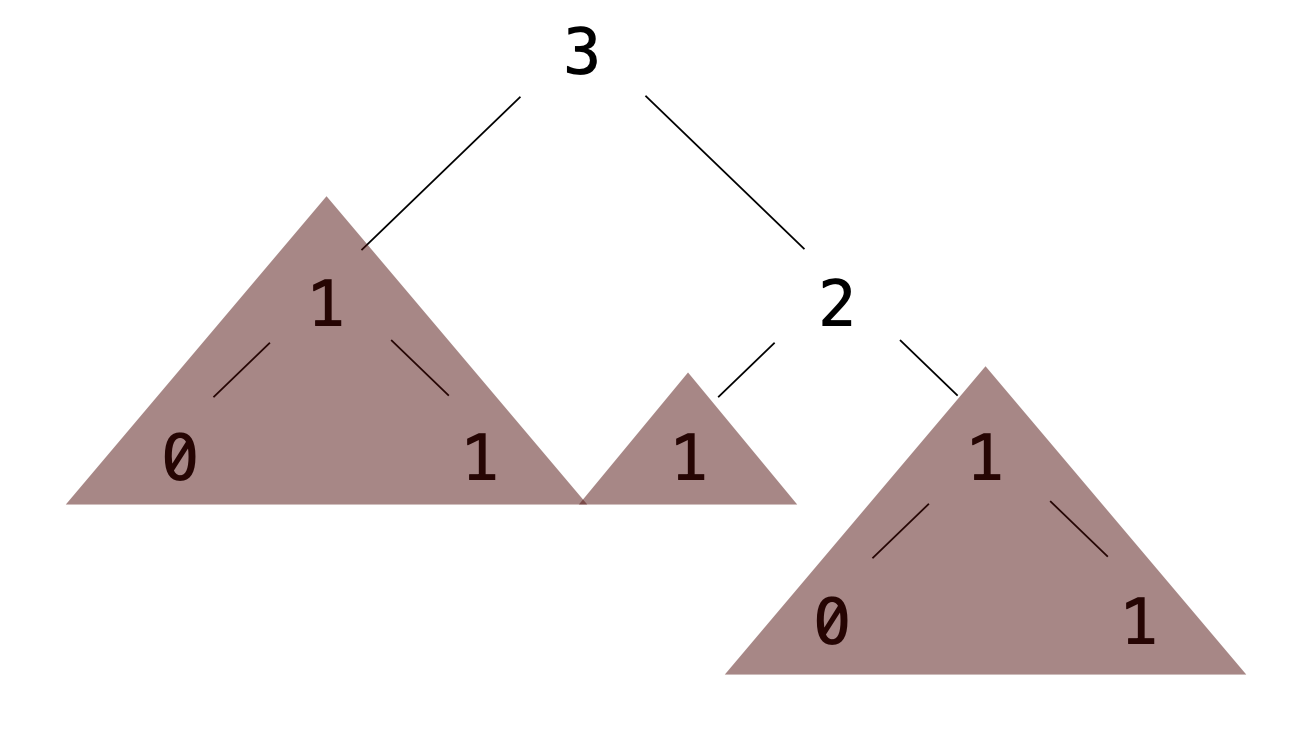
Removing subtrees from a tree is called pruning.
Always prune branches before recursive processing.
                    def prune(t, n):
                        """Prune all sub-trees whose label is n.
                        >>> t = Tree(3, [Tree(1, [Tree(0), Tree(1)]), Tree(2, [Tree(1), Tree(1, [Tree(0), Tree(1)])])])
                        >>> prune(t, 1)
                        >>> t
                        Tree(3, [Tree(2)])
                        """
                        t.branches = [___ for b in t.branches if ___]
                        for b in t.branches:
                            prune(___, ___)
Exercise: Pruning trees (Solution)
Removing subtrees from a tree is called pruning.
Always prune branches before recursive processing.
                    def prune(t, n):
                        """Prune all sub-trees whose label is n.
                        >>> t = Tree(3, [Tree(1, [Tree(0), Tree(1)]), Tree(2, [Tree(1), Tree(1, [Tree(0), Tree(1)])])])
                        >>> prune(t, 1)
                        >>> t
                        Tree(3, [Tree(2)])
                        """
                        t.branches = [b for b in t.branches if b.label !=n]
                        for b in t.branches:
                            prune(b, n)
Recursive objects
Why are Tree and Link considered recursive objects?
Each type of object contains references to the same type of object.
- An instance of
Treecan contain additional instances ofTree, in thebranchesvariable. - An instance of
Linkcan contain an additional instance ofLink, in therestvariable.
Both classes lend themselves to recursive algorithms. Generally:
- For
Tree: The base case is whenis_leaf()is true;
the recursive call is on thebranches. - For
Link: The base case is when the rest isempty;
the recursive call is on therest.
Python Project of The Day!
Exotic Trees
A Field Guide to Exotic Trees: A gallery of trees programmatically
generated from a Python script.